

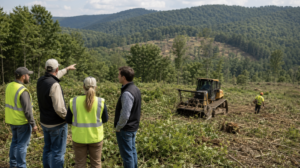
Richwood sits in a landscape where business property, forestland, utility access, road frontage, recreational acreage, and undeveloped parcels often meet within the same stretch of ground. That setting creates opportunity, but it also creates an ongoing responsibility. Vegetation that appears manageable during one season can become a serious operational concern after another cycle of rapid growth, storm damage, invasive spread, or neglected maintenance.
For companies, landowners, developers, utilities, public agencies, and organizations responsible for substantial acreage, vegetation management is no longer a cosmetic service. It is part of protecting access, supporting safety, preserving usable land, controlling long-term costs, and presenting property as a viable asset. 🌿 In a community closely connected to the surrounding Appalachian landscape, the condition of large properties can influence individual businesses as well as wider economic confidence.
The history and geography of Richwood, West Virginia make this especially relevant. Richwood developed around timber, industry, transportation, and natural resources, and the city remains closely associated with the Monongahela National Forest and the mountainous terrain of eastern Nicholas County. Those characteristics give the area a distinctive identity, but they also mean that unmanaged growth can quickly interfere with roads, structures, drainage systems, fences, trails, work zones, and future development plans.
Vegetation Management Protects the Practical Value of Business Property
A large parcel can look impressive on paper while being difficult to use in practice. Dense brush may conceal damaged fencing, unstable ground, discarded materials, drainage problems, erosion, or unauthorized access points. Overgrown areas can make routine inspections slower and more expensive. They can also prevent owners from accurately evaluating how much of the property is suitable for equipment, storage, agriculture, recreation, expansion, or development.
Professional vegetation management restores visibility and access. It allows decision-makers to see the actual condition of the land instead of making plans around a wall of weeds, saplings, vines, and tangled undergrowth. This is particularly important when a business is preparing for an appraisal, insurance review, sale, lease, construction project, or site assessment.
West Virginia’s economic development efforts consistently emphasize the importance of usable sites, available buildings, infrastructure, and land that can support new or expanding operations. The West Virginia Division of Economic Development promotes the state’s diverse commercial and industrial locations, including forested property and developable acreage. Land that is accessible, maintained, and easier to evaluate is naturally better positioned to support those opportunities.
Overgrowth Can Turn Routine Maintenance Into a Major Expense
Vegetation rarely becomes expensive all at once. Costs usually build quietly. A narrow access lane becomes partially blocked. Small saplings become established near a fence. Vines begin climbing structures. Brush spreads into drainage channels. Trees crowd utility corridors. By the time the property owner responds, the work may require heavier equipment, more labor, specialized removal, and additional site repair.
Scheduled management gives businesses more control over that cycle. Clearing, mowing, selective cutting, mulching, and targeted treatment can be planned around seasonal growth and the intended use of each section of land. A maintained property is generally easier to service than a neglected property that must be reclaimed repeatedly.
This matters to local business stability. The Richwood Chamber of Commerce identifies business prosperity, civic improvement, commercial interests, and the welfare of the surrounding area as part of its mission. Well-managed commercial and institutional properties contribute to that broader picture by improving appearance, protecting access, and reducing the chance that preventable land problems become costly disruptions.
Safety Begins With Clear Access and Better Visibility
Large acreage often includes areas that are not visited every day. Equipment may be stored at the edge of a field. Utility components may be positioned beyond the main building. Workers may need to reach remote gates, pipelines, drainage structures, communication equipment, or forest boundaries. When those routes are obstructed, a simple inspection can become difficult.
Vegetation management helps maintain clear sightlines and usable access for employees, contractors, emergency responders, and service vehicles. It may also reduce hidden tripping hazards, improve visibility around intersections and entrances, and make it easier to identify damaged trees or limbs before they fall onto roads, buildings, or work areas.
This does not mean removing every plant from a property. Effective management is selective. The goal is to control vegetation according to risk, land use, environmental conditions, and the owner’s objectives. Some areas may need regular mowing, while others benefit from brush cutting, forestry mulching, invasive plant control, or the preservation of desirable native growth.
Environmental Responsibility Is Now Part of Business Planning
Businesses are increasingly expected to understand how their land-management decisions affect soil, water, habitat, and neighboring properties. Poorly planned clearing can expose soil, worsen erosion, disturb drainage patterns, or spread invasive species. Leaving acreage completely unmanaged can create a different set of problems, including blocked waterways, aggressive plant growth, and reduced access for corrective work.
The West Virginia Department of Environmental Protection is responsible for programs that protect the state’s air, land, and water. Its work highlights the connection between land use, runoff, water quality, and responsible environmental management. Business owners do not need to treat every mowing project as an environmental engineering project, but larger or more sensitive sites should be approached with awareness of drainage, slopes, wetlands, waterways, and permit requirements.
A thoughtful vegetation plan can maintain access while leaving appropriate buffers, retaining useful trees, protecting sensitive ground, and encouraging plants that suit the site. This balance is especially important in West Virginia, where steep slopes and heavy rainfall can magnify the effects of disturbed soil.
Invasive Plants and Forest Health Can Affect Commercial Land
Invasive vegetation can spread rapidly across underused acreage, rights-of-way, disturbed soil, and forest edges. Once established, aggressive species may crowd out desirable plants, interfere with maintenance, reduce visibility, and require repeated control. The problem can cross property boundaries, which means delayed action on one parcel may create complications for adjacent landowners.
The West Virginia Department of Agriculture maintains forest-health programs and information related to pests and threats affecting the state’s trees and plant resources. This is relevant to businesses that own timberland, recreational property, industrial acreage, agricultural ground, or parcels bordering wooded areas. A vegetation contractor familiar with regional conditions can help identify suspicious growth and recommend an appropriate management approach rather than simply cutting everything at the same height.
Research-based guidance also matters. WVU Extension provides resources related to horticulture, sustainable land practices, agriculture, natural resources, and large-scale cultivation. These resources reinforce the value of matching management methods to site conditions instead of relying on a single technique for every acre.
Managed Acreage Supports Expansion and Investment
A company considering expansion needs to know where future buildings, parking, storage, utilities, access roads, or outdoor work areas could be placed. When vegetation prevents accurate measurement and inspection, planning slows down. Surveyors, engineers, environmental consultants, and construction teams may need additional time simply to reach the areas they are evaluating.
Cleared and maintained access does not guarantee that a site is developable, but it makes due diligence more efficient. It can also help owners identify issues early, before money is committed to a design that does not fit the land.
For property owners seeking buyers or tenants, presentation matters as well. A maintained entrance, visible boundaries, open access routes, and controlled growth communicate that the property is being actively managed. That impression can influence how seriously a site is considered, especially when competing properties are easier to inspect.
Large Acreage Management Strengthens Rural Business Resilience
Rural businesses often operate with fewer nearby service providers, longer travel distances, limited alternate access routes, and greater exposure to weather-related disruptions. That makes preventive property maintenance especially valuable. A blocked lane, fallen tree, flooded ditch, or inaccessible utility area can have a greater impact when there is no immediate workaround.
The Appalachian Regional Commission supports economic development across West Virginia by investing in infrastructure, entrepreneurship, community capacity, and opportunities built around local assets. Vegetation management fits into this larger resilience picture because functional land supports business continuity, recreation, tourism, agriculture, forestry, transportation, and future investment.
Richwood’s natural setting is one of its strongest assets. Protecting that setting does not require allowing every commercial parcel to become inaccessible. Responsible management can preserve the character of the land while making it safer, more productive, and more useful to the people and organizations that depend on it.
The Right Approach Depends on the Acreage
Not every property needs the same equipment or schedule. Open fields may require periodic mowing or brush hogging. Thick undergrowth may call for forestry mulching. Fence lines and building perimeters may need selective clearing. Rights-of-way may require recurring maintenance to protect access and visibility. Steep, wet, rocky, or heavily wooded terrain may demand specialized equipment and careful staging.
A capable provider should consider acreage size, slope, soil conditions, existing vegetation, access limitations, nearby structures, waterways, intended land use, and the owner’s timeline. The strongest plan is not necessarily the one that removes the most vegetation. It is the one that produces a controlled, usable property without creating unnecessary damage or recurring problems.
Businesses seeking Large Acreage Vegetation Management Richwood WV should look for a service that can evaluate the entire site, explain the proposed method, identify areas requiring special care, and establish a realistic maintenance strategy. That approach creates more lasting value than a one-time cut performed without regard for what the property needs next.
Conclusion
Large acreage vegetation management has become a business priority because land condition affects far more than appearance. It influences safety, accessibility, maintenance costs, environmental responsibility, emergency response, site planning, property value, and the ability to expand.
In Richwood, where commercial property is closely connected to forests, slopes, waterways, roads, and rural infrastructure, unmanaged growth can create avoidable obstacles. Businesses that address vegetation before it becomes a crisis gain a clearer understanding of their property and more control over future expenses.
The strongest strategy is proactive, site-specific, and tied to the way the land is actually used. By maintaining access, controlling aggressive growth, protecting sensitive areas, and planning ahead, property owners can turn large acreage from a recurring liability into a better-managed business asset.