

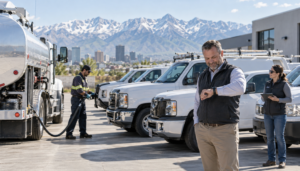
For businesses that depend on trucks, construction equipment, generators, service vehicles, and other fuel-powered assets, every minute spent away from the job can affect productivity. Across the Salt Lake Valley, business owners and fleet managers are paying closer attention to ways they can reduce downtime, simplify operations, and keep employees focused on revenue-producing work.
One solution gaining attention is mobile fuel delivery. Instead of sending employees and vehicles away from a facility, construction site, yard, or jobsite to refuel, businesses can have fuel delivered directly where their equipment is located. 🚚
The appeal is easy to understand. Fuel is essential, but obtaining it does not have to consume valuable employee time. For companies operating throughout Salt Lake City and the surrounding communities, professional Mobile Fuel Delivery Salt Lake Valley service can turn routine fueling into a more organized part of daily business operations.
Salt Lake City sits at the center of one of the West’s important commercial regions. The broader history and development of Salt Lake City have been closely tied to transportation, commerce, regional access, and its position along the Wasatch Front. Those characteristics continue to matter for businesses that depend on moving people, products, equipment, and materials efficiently.
Time Spent at the Fuel Station Is Time Away From the Business
A trip to the gas station may appear minor when considered as a single event. For a company operating several trucks or pieces of equipment, however, those trips can become a recurring operational expense.
An employee may need to stop working, drive to a fueling location, wait for an available pump, fuel the vehicle or equipment, complete the transaction, and then return to the original location. Traffic and busy fueling periods can extend that process even further.
Multiply that routine across a fleet and across hundreds of working days, and the amount of productive time being redirected toward fueling can become significant.
Mobile delivery changes the process. Fuel comes to the vehicles instead of requiring the vehicles to go to the fuel.
For a contractor preparing crews for an early morning start, that might mean trucks are already fueled when employees arrive. For a company with equipment operating from a central yard, multiple pieces of equipment may be fueled together rather than individually. For businesses with generators, machinery, or equipment that is inconvenient to move, direct delivery can eliminate transportation issues altogether.
The result is not simply convenience. It is a different approach to managing one of the recurring necessities of operating a fuel-dependent business.
Salt Lake Valley Businesses Operate in a Growing Commercial Market
The need for efficient business infrastructure becomes increasingly important as a region grows.
The Salt Lake City Department of Economic Development describes a local economy that includes industries such as logistics, manufacturing, distribution, healthcare, finance, life sciences, outdoor products, and other important sectors. The department also reports that Salt Lake City is home to more than 20,000 businesses.
Many of these industries depend directly or indirectly on transportation and equipment.
Construction companies need excavators, loaders, trucks, compressors, and generators operating when crews need them. Delivery companies rely on vehicles remaining available. Landscapers depend on trucks and equipment moving between properties. Warehousing and distribution operations depend on predictable transportation. Service companies may have employees traveling throughout the valley every day.
For these businesses, fuel management is not an isolated purchasing decision. It is connected to scheduling, labor, fleet management, equipment availability, and customer service.
The Salt Lake Chamber, which dates to 1887 and describes itself as Utah’s largest and longest-serving business association, focuses on economic prosperity and a strong environment for businesses throughout the state. As the region continues attracting businesses and investment, operational efficiency becomes increasingly important for companies trying to remain competitive.
Mobile Fuel Delivery Can Help Reduce Hidden Labor Costs
The price displayed on a fuel pump is only one component of the true cost of refueling a commercial fleet.
Employee time has value. Vehicle mileage has value. Delays have value. Equipment sitting idle has value.
Consider a company that has employees refueling work trucks several times each week. Even relatively short trips can add up when they occur repeatedly across multiple employees and vehicles. The business is effectively paying workers to perform a task that does not directly complete a job, deliver a product, serve a customer, or produce revenue.
There can also be indirect costs. Additional driving increases vehicle mileage. Employees may encounter traffic. Work schedules can be interrupted. Crews can arrive at jobs at different times because some vehicles need fuel before departure.
Mobile fueling creates an opportunity to consolidate that activity.
Instead of dozens of separate fueling trips, fuel can be delivered directly to the company’s location or jobsite according to its operational needs. This allows business owners to evaluate fuel not simply according to the price per gallon but according to the total cost associated with obtaining and managing it.
For companies operating multiple vehicles or equipment, that distinction can become increasingly important.
A Strong Regional Workforce Makes Productivity Even More Valuable
Salt Lake Valley represents a substantial employment center.
The U.S. Bureau of Labor Statistics Salt Lake City-Murray metropolitan area data tracks employment, wages, unemployment, and other economic indicators across the region. BLS data illustrate the scale and diversity of the metropolitan workforce and the many industries contributing to the area’s economy.
For an employer, labor is one of the most valuable resources available.
Saving a few minutes once may not transform a company’s financial results. Saving employee time repeatedly across numerous vehicles, crews, locations, and months can be different.
That is why operational improvements are often most valuable when they address activities that occur again and again.
Fueling is exactly that type of activity.
A contractor may need fuel every working day. A transportation company may need it every shift. A landscaping company may operate numerous trucks and machines throughout the week. A facility with backup generators must maintain fuel availability even when the equipment is not being used continuously.
Reducing the labor connected with these repeated activities gives managers another way to improve productivity without asking employees to work faster or longer.
Reliable Fuel Access Helps Businesses Keep Equipment Moving
Downtime can become expensive quickly when equipment is needed to complete scheduled work.
A truck without fuel cannot make a delivery. A loader without fuel cannot move material. A generator without fuel cannot provide backup power. Construction equipment that runs dry can interrupt an entire crew.
Mobile fuel delivery helps businesses take a more proactive approach.
Instead of relying entirely on individual drivers or equipment operators to notice fuel levels and make separate trips, companies can incorporate fueling into a planned operating schedule. Fuel can be delivered where vehicles and equipment are already located, helping businesses prepare assets for upcoming work.
This can be especially valuable for companies managing numerous vehicles or machines simultaneously.
The economic scale of Salt Lake County also makes efficiency increasingly relevant. According to U.S. Census Bureau QuickFacts for Salt Lake County, the county had more than 35,000 employer establishments in 2023, along with substantial employment in sectors including transportation, warehousing, retail, healthcare, food services, and other industries.
Behind many of those businesses are vehicles and equipment that must remain operational.
Construction and Jobsite Operations Can Benefit Significantly
Construction is one of the clearest examples of where mobile fueling can improve daily logistics.
Heavy equipment is not designed to make convenient trips to a neighborhood fuel station. Excavators, loaders, generators, compressors, skid steers, and other machinery may remain at a project site for extended periods.
Traditionally, businesses may transport fuel themselves, send equipment to another location when possible, or assign employees to manage refueling.
Direct fuel delivery simplifies the process by bringing fuel to the jobsite.
It can also help project managers maintain a more predictable schedule. Crews arriving in the morning can begin work with fueled equipment instead of discovering that a machine needs fuel before the day’s work can proceed.
In an industry where scheduling multiple crews, subcontractors, deliveries, inspections, and equipment is already complicated, eliminating one avoidable interruption has practical value.
Fleet Operators Gain Better Control Over Daily Fueling
Fleet-based businesses face a different challenge.
A company may have delivery trucks, service vehicles, vans, pickups, or other commercial vehicles leaving its facility throughout the day. When each driver becomes responsible for fueling independently, managers have less control over when and where fueling occurs.
Drivers may stop at different stations. Some may refuel before a shift while others do it afterward. Receipts and purchases may require additional administrative tracking.
Centralized mobile fueling can create a more consistent process.
Vehicles can potentially be fueled while parked at the company’s yard or facility, allowing employees to begin their routes without making a fuel stop first.
This matters in a metropolitan area where commercial activity continues to expand. The Utah Governor’s Office of Economic Opportunity supports business recruitment, expansion, entrepreneurship, and economic development throughout the state while highlighting Utah’s continuing emphasis on economic performance and business growth.
As businesses expand, small inefficiencies that were manageable with three vehicles can become much more expensive with 10, 20, or 50.
Fuel Delivery Can Become Part of a Broader Efficiency Strategy
Mobile fueling works best when considered as part of a larger operational strategy rather than merely another way to purchase fuel.
Successful businesses constantly examine how resources move through their operations. They analyze employee scheduling, vehicle routes, equipment use, inventory, maintenance, purchasing, and other repetitive activities.
Fuel belongs on that list.
A company may discover that employees spend more time fueling than management previously realized. Another may find that equipment occasionally sits idle while waiting for fuel. Another may simply want drivers concentrating on customer appointments instead of stopping at gas stations.
These are operational issues rather than fuel-price issues.
Recent reporting from The Salt Lake Tribune on downtown Salt Lake City’s economy has highlighted continued investment, business activity, visitor spending, and development in the urban core. Growth of this kind creates opportunities, but it also increases the importance of efficient logistics for the businesses serving a busy metropolitan market.
Companies capable of completing more work with the same workforce and equipment can place themselves in a stronger position to handle growth.
Convenience Matters, but Business Continuity Matters More
Convenience is one of the most visible benefits of mobile fuel delivery, but continuity may ultimately be more important.
Companies depend on knowing that essential resources will be available when they are needed. Fuel belongs in the same category as equipment, employees, materials, inventory, and power.
A planned fuel delivery strategy can help businesses reduce unnecessary interruptions and prepare for operating demands in advance.
That does not mean every company will use fuel delivery in exactly the same way. A construction contractor may prioritize jobsite equipment. A fleet company may prioritize overnight truck fueling. A property management company may need generator fuel. An industrial operation may have equipment with completely different consumption patterns.
The value comes from adapting fuel delivery to how the business actually operates.
Instead of forcing operations to revolve around trips to fueling stations, companies can make fuel availability fit their schedules.
Less Time Fueling Can Mean More Time Serving Customers
Business owners spend considerable energy finding ways to attract customers, win contracts, improve service, and grow revenue.
Yet profitability is influenced just as much by what happens behind the scenes.
A company that reduces unnecessary driving, idle time, administrative work, and employee interruptions may improve efficiency without changing the product or service it sells.
Mobile fuel delivery represents this kind of behind-the-scenes improvement.
Customers may never know that a contractor’s equipment was fueled before sunrise or that a service company’s fleet was filled while parked overnight. They simply experience the result when crews arrive on time, equipment is ready, and work proceeds without avoidable interruptions.
That is ultimately where operational efficiency becomes customer service.
Conclusion
Salt Lake Valley businesses operate in a region built around movement, commerce, development, and continued economic activity. From contractors and transportation companies to landscapers, service fleets, industrial operators, and businesses relying on backup generators, fuel remains essential to keeping work moving.
The traditional approach of sending employees and vehicles to fuel stations may still work, but it is no longer the only option.
Mobile fuel delivery allows businesses to bring fuel directly to vehicles, equipment, facilities, and jobsites. That shift can help reduce unnecessary trips, recover employee time, limit interruptions, simplify fleet operations, and keep essential equipment ready for work.
For business owners focused on controlling costs, improving productivity, and getting more value from the resources they already have, the benefit is straightforward. Fuel should support the work rather than interrupt it.
In a growing and competitive Salt Lake Valley business environment, even ordinary operational improvements can make a meaningful difference. Companies that find smarter ways to manage repetitive tasks are better positioned to keep crews working, vehicles moving, customers served, and business moving forward.